
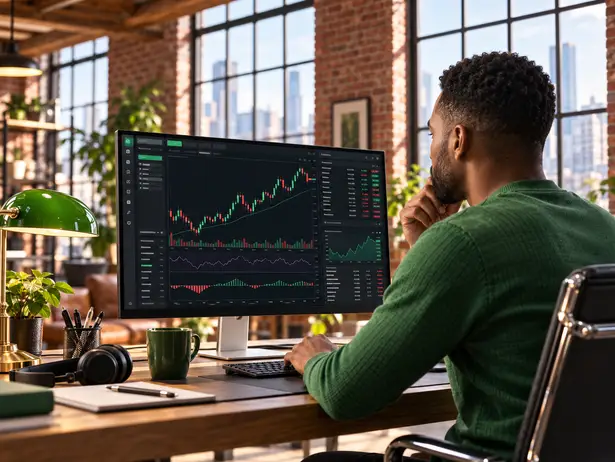
Day trading futures can be an exciting way to participate in the financial markets, but success requires much more than simply clicking Buy or Sell.
At Trade With Dana, the focus is on helping developing traders understand the market, build structure, manage risk, and create better trading habits before increasing their trading activity.
For beginners, one of the biggest challenges is not finding trades. It is learning when to trade, when to wait, how to protect capital, and how to make decisions based on a plan instead of emotion.
This beginner’s guide explains what futures trading is, how day trading futures works, and some of the important steps to consider before entering the market.
What Is Futures Trading?
Futures trading involves buying and selling contracts connected to the future value of an underlying market or asset.
Unlike traditional investing, where someone may hold stocks or other investments for months or years, futures traders may hold positions for much shorter periods of time.
Day traders typically enter and exit their positions within the same trading day.
Futures contracts are available across several different markets, including:
- Stock indexes
- Commodities
- Currencies
- Energy markets
- Interest rates
- Cryptocurrencies
Popular futures markets among active traders include contracts connected to major indexes such as the S&P 500, Nasdaq, and Dow Jones.
What Is Day Trading Futures?
Day trading futures means opening and closing futures positions during the same trading day.
A day trader generally looks for shorter-term price movements rather than holding a position as a long-term investment.
For example, a trader may review the market in the morning, identify important price levels, wait for a setup that matches their strategy, enter a position, and then close that position before the trading session ends.
At Trade With Dana, one of the most important ideas for beginners is understanding that being a day trader does not mean you have to trade all day.
Sometimes the best trading decision is waiting.
Day trading requires several skills, including:
- Understanding price movement
- Reading market structure
- Managing emotions
- Following a trading plan
- Controlling risk
- Developing patience
Dana’s Trading Note
You do not have to take every move you see.
A missed trade is not always a mistake. Learning to wait for a setup that actually matches your trading plan can be just as important as learning when to enter the market.
Why Do Traders Choose Futures?
Futures markets have several features that attract active traders.
High Market Liquidity
Many popular futures markets have significant trading activity, which can make it easier for traders to enter and exit positions.
Extended Trading Hours
Many futures products trade for much of the day and night during the trading week.
This gives traders more flexibility to study different market sessions and determine which trading hours work best for their schedules.
Leverage
Futures contracts allow traders to control a position with a smaller amount of capital than the full value of the contract.
However, leverage works both ways.
While leverage can increase potential gains, it can also increase losses very quickly.
That is why risk management is a major part of the Trade With Dana approach.
Understanding Full-Size and Micro Futures Contracts
Beginners may hear terms such as E-mini futures and Micro E-mini futures.
These contracts can represent the same general market while having different contract sizes and dollar values.
For example, traders interested in the Nasdaq may see both:
- NQ — E-mini Nasdaq-100 futures
- MNQ — Micro E-mini Nasdaq-100 futures
Micro contracts are smaller than their E-mini counterparts.
For developing traders, smaller contract sizes may provide an opportunity to practice position management while using less exposure than a larger contract.
That does not mean micro futures are risk-free. A trader can still lose money quickly without proper risk controls.
Steps to Start Day Trading Futures
1. Learn How Futures Markets Work
Before placing your first trade, learn the basic mechanics of futures trading.
Important concepts include:
- Futures contracts
- Contract sizes
- Tick values
- Margin requirements
- Trading hours
- Volatility
- Order types
- Stop losses
A trader should understand what one tick or one point is worth before entering a position.
At Trade With Dana, education comes before increasing risk.
Understanding what you are trading is part of protecting yourself.
2. Choose One or Two Markets to Study
New traders often make the mistake of trying to watch everything.
They may jump from Nasdaq futures to gold, crude oil, S&P futures, Bitcoin, and several other markets.
That can become overwhelming very quickly.
Instead, consider learning one market deeply before expanding.
Common futures categories include:
Index Futures
Index futures track major stock indexes.
Examples include futures connected to the Nasdaq, S&P 500, Dow Jones, and Russell 2000.
Commodity Futures
Commodity futures include markets such as:
- Gold
- Crude oil
- Natural gas
- Agricultural products
Currency Futures
Currency futures allow traders to participate in movements involving different currencies.
Your market should match your trading schedule, experience level, strategy, and personal risk tolerance.
3. Learn Market Analysis
Traders use different approaches to understand what price may be doing.
Technical Analysis
Technical analysis focuses on price charts and market behavior.
Common tools may include:
- Support and resistance
- Trend analysis
- Volume
- Moving averages
- Candlestick patterns
- VWAP
- Previous highs and lows
Indicators can be helpful, but they should not replace understanding what price is actually doing.
Market Structure
Market structure can help traders understand whether price is trending, ranging, or changing direction.
Traders may study:
- Higher highs
- Higher lows
- Lower highs
- Lower lows
- Breakouts
- Pullbacks
- Key price levels
- Areas where price previously reacted
At Trade With Dana, the goal is not to predict every candle.
The goal is to understand the larger picture and make a structured decision.
Dana’s Trading Note
Before entering a trade, ask yourself:
Where is price coming from? Where is it now? Where could it reasonably go next?
That question can help prevent traders from entering simply because a candle suddenly moved.
4. Create a Trading Plan
A trading plan helps create consistency.
Your plan may include:
- Which market you trade
- Which trading session you trade
- Your entry criteria
- Your exit criteria
- Your maximum risk per trade
- Your maximum daily loss
- Your preferred contract size
- When you stop trading
- Situations where you do not trade
Without rules, it becomes easier to make decisions based on excitement, fear, frustration, or the desire to win back a loss.
At Trade With Dana, structure matters.
A trader should know the rules before the market starts moving quickly.
5. Practice in Simulation
Before risking real money, consider spending time in a simulated trading environment.
Simulation can help you:
- Learn your platform
- Practice order entry
- Test a strategy
- Study price movement
- Practice stop placement
- Review your mistakes
- Build familiarity with your market
Simulation is especially useful for learning mechanics.
However, simulated trading does not fully recreate the emotions that can come with real money.
That is why developing discipline during simulation is important.
Dana’s Trading Note
Treat your simulation account seriously.
If you practice breaking your rules in simulation, it becomes harder to suddenly become disciplined when real money is involved.
Risk Management: One of the Most Important Trading Skills
Many new traders spend most of their time looking for the perfect indicator or entry strategy.
Risk management deserves just as much attention.
At Trade With Dana, protecting capital is part of the trading strategy.
Set a Maximum Risk Per Trade
Avoid putting too much of your account at risk on a single position.
One losing trade should not place your entire trading account in danger.
Use Stop Losses
A stop-loss order can help limit losses by closing a trade when price reaches a predetermined level.
A stop should be part of the trading decision before entering the trade rather than something decided after the market begins moving against you.
Set a Maximum Daily Loss
A daily loss limit can help prevent one difficult trading session from becoming a much larger problem.
When the limit is reached, trading should stop according to the rules established in the trading plan.
Avoid Overtrading
More trades do not automatically mean more profit.
Overtrading can happen when traders:
- Chase price
- Trade out of boredom
- Try to recover a loss
- Enter without confirmation
- Continue trading after reaching their planned stopping point
Quality matters more than quantity.
Scale Gradually
There is no need to rush into larger contract sizes.
A developing trader can focus first on consistency, execution, discipline, and following the trading plan.
As experience develops, position size can be evaluated based on account size, risk tolerance, and proven performance.
At Trade With Dana, the goal is not to become bigger quickly.
The goal is to become better first.
Common Mistakes New Futures Traders Make
Trading Without a Plan
Entering trades without clearly defined rules can create inconsistent results.
Using Too Much Leverage
Large positions can create significant losses very quickly.
Chasing the Market
Entering after a large move because you are afraid of missing out can lead to poor entries and unnecessary risk.
Letting Emotions Control Decisions
Fear, greed, frustration, and excitement can cause traders to abandon their strategy.
Revenge Trading
Trying to immediately recover a loss can lead to larger losses and poor decision-making.
Switching Strategies Constantly
A trader may struggle to learn anything deeply when changing indicators, markets, and strategies every few days.
Expecting Quick Results
Trading is a skill.
Skill development takes repetition, review, patience, and time.
How Long Does It Take to Learn Futures Trading?
There is no single timeline.
Every trader learns differently.
Progress can depend on:
- Time spent studying
- Quality of education
- Practice habits
- Market experience
- Ability to follow rules
- Emotional discipline
- Risk management
The goal should not be to rush toward profits.
The goal should be to build skills that can be repeated consistently.
Building Your Trading Routine
A simple trading routine may include:
Before the trading session:
- Review higher timeframes
- Mark important support and resistance
- Identify major market levels
- Review scheduled economic news
- Check platform and internet connection
- Confirm risk settings
- Review your trading plan
During the session:
- Wait for your setup
- Follow position-size rules
- Use predetermined stops
- Avoid chasing price
- Stop trading when your rules say to stop
After the session:
- Review your trades
- Record mistakes
- Save screenshots
- Identify what you followed correctly
- Look for patterns in your behavior
At Trade With Dana, the trading journal is not only about profit and loss.
It is also about learning how you make decisions.
Final Thoughts
Day trading futures requires education, preparation, risk management, patience, and discipline.
There are opportunities in the futures market, but there is also significant risk.
A beginner does not need to know everything on the first day.
Start by learning the market, understanding your platform, practicing in simulation, creating trading rules, and developing the discipline to follow those rules.
Trade With Dana is built around a simple idea: learn the process, protect your capital, develop your discipline, and grow at a pace you can manage.
You do not need a noisy trading environment or dozens of strategies.
You need a process you understand and rules you can follow.
Ready to Learn More?
If you are beginning your trading journey and want a more personal, structured learning environment, Trade With Dana offers education designed to help developing traders understand futures trading, risk management, market structure, and the habits required to become more disciplined. I am kind of biased but would encourage you to visit www.tradewithdana.com to discover how having the right trading coach could increase your trading endeavor.
Learn. Plan. Trade. Succeed.
Educational purposes only. Futures trading involves substantial risk and is not suitable for every trader. Past performance does not guarantee future results.